A chance encounter at a grocery store a couple weeks ago allowed me to run into John Gilderbloom. Dr. Gilderbloom is a professor at U of L, and is a noted and quoted authority on urban revitalization with a heavy reliance on the effect two-way streets have in bringing about such revival.
He and I had met several years ago for a discussion of our building in Louisville.
Dr. Gilderbloom mentioned that he is off to Europe soon to preach his gospel of things urban. He said it would be a help to him if he could have a shakedown cruise of his material before he crosses the ocean. I asked if he'd like to run through his presentation in New Albany since we are always looking for good ideas on how to improve our city.
He accepted the invitation, and will speak at the STRASSWEG AUDITORIUM in the basement of the New Albany Library, TUESDAY, AUGUST 4, 2015 at 6:00 PM.
Dr. Gilderbloom is a bit of a shy, reticent, fellow; a typical academic type. But his grasp of his subject material is wide and strong. An informative and engaging presentation awaits those who attend. So, please come help Dr. Gilderbloom get ready for his European visit.
Tuesday, July 21, 2015


Sunday, July 19, 2015
New Rules
Cluck cluck, plop? Plop, cluck cluck? Which came first, the chicken, or the egg? Which comes first, the private, or the public?
At the July 16th City Council meeting I found myself in a strange situation. I was voting against something at Council which I had previously voted for on the Redevelopment Commission. What brought about this change in thought?
First of all, my previous votes for the project were somewhat reluctant because it is such a big deal. And I have a persistent feeling that a project of this scale, in such a strategic position in our downtown -- that is, spatially, conceptually, and philosophically--deserves a higher level of study, input from citizens, and more in-depth consideration than a run of the mill ten-house development at the city's fringe.
We are told that this is a public/private partnership. We are given to believe that such deals are a wave of the future. As government is dismantled by the Tea Party set, it is these public/private partnerships which will get the job done, which will build our cities, toll our roads, define our path forward. As Pink Floyd assured us, "it's alright, we told you what to dream."
And as we arrived at crunch time, it hit me. This is the riddle we must solve. How do we, how does a government of the people, by the people, and for the people adjust to a pecking order where now it is often government of the corporation, by the corporation and for the corporation? Some will say, government and business should simply hold hands and let business guide us on the path to prosperity, civic rejuvenation, and a functional country, state, or city.
The presentation at the Council meeting the other night was informative and, frankly, resolved at least one of my concerns about the project relating to bankruptcies of the developer. I am not opposed to spending municipal funds on a definitional project of any scope which promises to make our city stronger, more sustainable, or more attractive as a place to live and work. I believe that is a valid function of government, but, I believe the use of public money entitles the public to a greater say in what those funds will buy. It would have been better, however, if such presentations had been held earlier in the process, and had been structured to include as many citizens' views as possible.
While the Chicken v. Egg case may never be fully adjudicated, it is the precedent used in explaining to me why we can have no final plans for the project. It goes something like this, "The developers don't want to spend their money to get final plans ready only to have them pushed back across the table for revision, or even dismissal. They don't want to make those expenditures until they're certain the project is a GO."
Unspoken is the fear that getting the public involved might drag the process out inordinately, and cause the developer to spend money needlessly, or have the whole concept thrown out because of the adage that "too many cooks spoil the broth".
I'll admit either of those outcomes is possible. At the dawn of the Public-Private Partnership Era things might get a bit clunky, tedious, and frustrating if we continue to adhere to the old rules and old models. The Coyle project is not some two-bit subdivision. It is the future of this city. It requires a lot of public investment. New Albany is not a large city with an abundance of land to allow for a few misses, flubs and mistakes. This is one of the few large scale shots at something transformational in the downtown area. (This is not meant to minimize the exceptional work being done by several local entrepreneurs around town.) We need to hold the developer to the highest standard of design. We need a design with a long shelf life. We need to set the bar at the level we want; not let the developer tell us what they are going to do.
New Albany is committing as much as five million dollars to this project. Maybe it's a good project, maybe it could be better, but what's the final product going to look like? We don't know, because the developer hasn't told us if we will get a chicken or an egg.
We need new rules, special rules, to guide the use of public/private partnerships.
If we, as a community, or if the mayor and his team feel so strongly about the possibilities of a public/private partnership, let us as a community finance the design we want the private developer to complete. This should allay reluctance on the part of the developer to present finished plans subject to revision at all stages of the project.
We are waiting now for historic review of the plans; we are waiting for the Plan Commission to weigh in. But decisions which might upend the project are made increasingly difficult to voice as we reach its expected - foregone - conclusion.
There's a nagging voice in my head that keeps saying something about "privatizing gain while socializing loss." A hopeful voice adds a third way, "democratizing vision".
If public/private partnerships are the new way, we need new rules and new expectations of how the private side of the partnership delivers the public good, and how the public's investment translates into the community's vision. I would much rather arrive at the disappointing conclusion we have spent some money on a proposal that won't happen, than to go "all in", at much greater cost, on a project that won't stand the test of time. Let public money pay for plans, and revisions that meet public goals. Let the developer handle the shovels and share his expertise. That looks like a better partnership to me.
Sunday, June 7, 2015
It's Alright. Right?
While some on principles baptized
To strict party platform ties
Social clubs in drag disguise
Outsiders they can freely criticize
Tell nothing except who to idolize
And then say God bless him
While one who sings with his tongue on fire
Gargles in the rat race choir
Bent out of shape from society’s pliers
Cares not to come up any higher
But rather get you down in the hole
That he’s in
But I mean no harm nor put fault
On anyone that lives in a vault
But it’s alright, Ma, if I can’t please him
--Bob Dylan, It's alright Ma
Although it seems a long time ago it was just last Monday, June 1, that the City Council chamber erupted in a surreal display of short-circuitry. Epithets were pitched, and caught by the electronic glove of WAVE TV's news cameras. Seemingly settled expressions of tolerance were recanted, then tossed onto the chamber's floor to be beaten into unrecognizability, as though an errant snake had slithered under the door.
Since then, a trip to the hardware store yielded this observation, "the City Council in Jeffersonville is pathetic too". (emphasis added)
At a public event for a Historic Society, "if a Republican had uttered the same kind of intolerant, homophobic remarks, (as were heard at the City Council last Monday) the Democrats would have crucified him, and the entire party. Looks kind of like a double standard."
A chance encounter with a fellow Councilman opens with, "how's it going, you lyin' piece of shit?" Je suis L.P.O.S.?
As a result of the purposefully obtuse characterization of my attempt to reach a bit of compromise on the issue of spoken prayer at a Council meeting, I've been called a racist, anti-prayer, in cahoots with un-named forces outside the Council, and beholden to a society-destroying agenda promoting human rights. I've also been reminded that thousands of voters will remember that I was out to strip prayer from the City
Council. I realize this controversy is not about me. But, as one maligned in such a ridiculous campaign to hoist the flag so the Christian Soldiers could March to War (by way of vote centers), I'll simply say, I'm sick of it.
I would add that many other bodies meet to conduct public business, without a ceremonial prayer or invocation at the start of the proceedings. (Board of Works, Redevelopment Commission, Sewer Board, County Council, County Commissioners, and other bodies no doubt, which I haven't named)
While the entire sordid evening was rife with the kind of bilious empty-headed rhetoric that has kept Jon Stewart on the air for many years now, I am simply addressing here the anti-prayer elements of the sideshow. What follows in italics is authored by me. I report. You decide.
WHEREAS: It is recognized that New Albany's Common Council meetings have opened with a Christian prayer,
WHEREAS: It is also recognized that some members do not believe sanctioned prayer is an appropriate form of expression in civic or government meetings,
NOW THEREFORE: The following outline of a compromise between these two diametrically opposed views is offered as a way of honoring both views through the individual preference of each Council member:
1. The Council will allow each member to open a meeting on a rotational basis.
2. The rotation shall be established by District number, just as the Council desks are arranged, until each member has been given the opportunity for opening remarks, whereupon the rotation will begin again.
3. The Council member who is responsible for the opening remarks following the rotation described, will be allotted one minute. The member can use none, any, or all of the time allotted.
4.The opening remarks shall be respectful and limited by the normal decorum expected in a public meeting, subject to the gavel of the chair.
5. The Council member's opening remarks may be a prayer, a reading, an historical note, or any other expression as limited by number 4 above.
6.The opening remarks are to be limited to expressions of an inspirational, centering, or focusing nature. The remarks shall not be used for campaigning or promotion of members' proposal or activities.
7. The Common Council shall address deviations from the prescribed format outlined here, and it shall revise with additional stipulations as need.
That was the basic idea which was then distilled into an amendment, as follows:
A Council member at every Common Council meeting, in rotation, may open the meeting with his or her choice of a prayer, a reading of an inspirational, commemorative or historical nature, or a moment of silent reflection.
What follows here is part of a note to Council members relating to the amendment above:
It is clear the U.S. Supreme Court rulings allow prayer at public meetings. It is equally clear that some citizens are so fully opposed to prayer in a governmental setting that they would resort to theatrical tactics to prove their point.
I believe a good way we can protect the dignity of the City Council (yes, I actually wrote those words) while respecting religious expression, and non-religious expression, as the Constitution and Court demands, is to take personal responsibility for the opening remarks at the Council meetings into our own hands. The proposal I've drawn up does that, I think. It allows prayers in the Council chamber, but makes any such prayers the responsibility of the members who choose to offer them. It likewise allows members who don't believe in the mixing of government and religion to express a sentiment in keeping with their beliefs. I believe it respects both sides of the issue while keeping the responsibility for the Council within the Council where, I believe, it belongs.
Objectively, can anyone playing with a full, non-demagogic, deck read that as an anti-prayer proposal?
I don't know if there's anything else to be done about this aberrant behavior. That's up to others to decide. I'm just one Councilman who probably has been/is being targeted for defeat because of these antics. But it is worth remembering that the State of Indiana has now coughed up two million dollars to help Gov. Mike Pence get his foot out of his mouth over the tainting of Indiana's image caused by the intolerance of the RFRA law he supported, which is the genesis of this local conflict. Beyond that cost, about a million and a half dollars were wasted in a vain attempt by the state's Attorney General to hold back the tide of history regarding same-sex marriage. So, to date, the fight which sparked the local tempest has cost the state about three and a half million dollars, and little evidence exists to show success burnishing the state's image.
The flow of history moves endlessly. It will leave some of us behind, but it won't be stopped.
Monday, April 27, 2015
Infrastructure of Sustainability
This article from earlier in the month appeared in the Courier-Journal. The article on the drought in California is relevant to us, here in New Albany, for a number of reasons: 1. evidence of climate change 2. noteworthy during the week of earth Day 3. validates the logic and exigencies of localism, independent businesses and sustainable communities.
Governor Jerry Brown has imposed sanctions to curtail the use of water in California. The arid state has long been on a knife's edge balanced between verdancy and drought. The great movie, Chinatown, showed through believable fiction, how desperately business interests coveted abundant water. In our part of the country, we worry through bothersome dry spells, but the rains usually come in sufficient volume to bail out farmers and we seldom need to resort to heavy conservation measures to help us through those spells.
For me this particular passage from the article is the money shot:
Retail price spikes are unlikely because of the drought, however. Only a small portion of what shoppers pay is based on what farmers get for their crops -- shipping, handling, packaging and marketing expenses are collectively bigger. Plus, food prices are often set on a global scale of supply and demand, so in a vast world marketplace, California's drought may not be a big factor, Sumner says.
People in California are scrambling to adjust to what seems like the new reality. They are taking steps to dial back water usage through more use of native plants rather than trying to have emerald green lawns. Farm workers are being bounced out by the reduced crop yields. People are beginning to envision a future where a less hospitable climate will erase discrete ecosystems, and place stress on wildlife in general.
Around here, locally, in our own backyards, in our daily routines in our small Midwest city, we can begin, and many have begun, to envision a future where, ' Only a small portion of what shoppers pay is based on what farmers get for their crops' may become a relic of a wasteful, unsustainable past. A friend of mine owns and operates a market that sells a wide range of locally grown produce. His store is open year round, but is naturally more well-stocked during spring, summer and early fall. All the items he sells comes from within a radius of 150 miles. The very nature of his business helps local growers become stronger. Those growers help stand against the collapse of local economies undermined by lost manufacturing jobs, and the devastation that trend has wrought on our economy. The concentration of food production in meteorologically vulnerable parts of the nation makes no sense when we see the ravages of drought in California. Where next will the comfortable past be 180ed into a new reality?
My friend's store doesn't appear to be a ticket to Easy Street. On the contrary, it is a tough, uphill battle trying to push people out of a rut of buying long-distance, insecticide-laden, produce from mega-farms. His produce isn't cheap, but as the article points out, under what passes for conventional agriculture today, only a small portion of the cost of produce goes to the farmer who produced it. Under the model my friend's producers follow, they earn more for their work, and so can more likely be a sustainable player in building a sustainable system, less vulnerable to capricious weather patterns, which obviously, is better for all of us. In a real sense, these producers are fighting for our futures as much as their own. They are helping to build a new infrastructure of sustainability.
Locally grown, or locally produced agricultural products are perhaps more easily perceived as part of a strong, healthy locality. But, in countless other commercial transactions we have the chance to, step by step, build a more vibrant, sustainable locality. These strong, varied, vibrant, prosperous localities are the infrastructure of sustainability. We can take steps here and now to make our own region more responsible, sustainable, and prosperous, by looking at how our daily commercial activities relate to, and affect our planet, which is truly our locality; New Albany's just a Zip Code.
Wednesday, April 15, 2015
Jeopardy--New Albany Style
Contestant number 1 (Lysistrata): I'll take "Big Yellow Taxi" for $800, Alex.
Alex Trebek: It's two photo clues... Johnny?
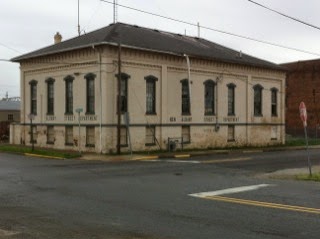
 Lysistrata: The old Street Department Headquarters, demolished in 1999.
Alex Trebek: In the form of a question, please.
Lysistrata: What is the old Street Department headquarters demolished in 1999?
Alex Trebek: Sorry...(contestant number 2) Sylvan?
Sylvan: What is the northern-most historical structure in downtown New Albany facing demolition by neglect?
Alex Trebek: Sorry...(contestant number 3)Damian?
Damian: What is an abject failure in the pursuit of preservation of historic structures in New Albany?
Alex Trebek: No, sorry players, the correct answer is, 'What is the next most likely historic structure in New Albany to fall victim to the Culbertson Avenue jinx?'
Just a note for future reference, we would have accepted either jinx, or curse, in that question.
Stay tuned. We'll be right back with Double Jeopardy. All I can say is, watch out.
________________________________________________________
If another game, instead of Jeopardy, say, What If, were played, the possible scenarios are limited only by imagination and vision.
I'll throw out a few what ifs:
What if it were converted to a public art space under the auspices of the Parks Department, sort of like the Studio 2000 program tried here, successfully, I might add, in 2005 and 2006?
What if it were used as a transitional shelter for disrupted families; those needing temporary shelter, refuge from abusive relationships, day services such as credit counseling, drug rehabilitation, or any of the myriad programs which help the disaffected get back on their feet?
What if, as community artist David Thrasher suggested, Fairview Cemetery were to be complemented by a sculpture garden; and this building were the locus of an accompanying exhibit, or repository of information about the magnificent reliquary art in the graveyard?
What if this property were swapped with the current headquarters of the Harvest Homecoming? The current HH HQ, being closer to the heart of downtown, could possibly be better incorporated into the commerce of the downtown district, thus helping to boost the revival of the downtown.
What if...?
The list is much longer than I've written, and as I said, limited only by imagination and vision.
Alex Trebek: It's two photo clues... Johnny?
Alex Trebek: In the form of a question, please.
Lysistrata: What is the old Street Department headquarters demolished in 1999?
Alex Trebek: Sorry...(contestant number 2) Sylvan?
Sylvan: What is the northern-most historical structure in downtown New Albany facing demolition by neglect?
Alex Trebek: Sorry...(contestant number 3)Damian?
Damian: What is an abject failure in the pursuit of preservation of historic structures in New Albany?
Alex Trebek: No, sorry players, the correct answer is, 'What is the next most likely historic structure in New Albany to fall victim to the Culbertson Avenue jinx?'
Just a note for future reference, we would have accepted either jinx, or curse, in that question.
Stay tuned. We'll be right back with Double Jeopardy. All I can say is, watch out.
________________________________________________________
If another game, instead of Jeopardy, say, What If, were played, the possible scenarios are limited only by imagination and vision.
I'll throw out a few what ifs:
What if it were converted to a public art space under the auspices of the Parks Department, sort of like the Studio 2000 program tried here, successfully, I might add, in 2005 and 2006?
What if it were used as a transitional shelter for disrupted families; those needing temporary shelter, refuge from abusive relationships, day services such as credit counseling, drug rehabilitation, or any of the myriad programs which help the disaffected get back on their feet?
What if, as community artist David Thrasher suggested, Fairview Cemetery were to be complemented by a sculpture garden; and this building were the locus of an accompanying exhibit, or repository of information about the magnificent reliquary art in the graveyard?
What if this property were swapped with the current headquarters of the Harvest Homecoming? The current HH HQ, being closer to the heart of downtown, could possibly be better incorporated into the commerce of the downtown district, thus helping to boost the revival of the downtown.
What if...?
The list is much longer than I've written, and as I said, limited only by imagination and vision.
Tuesday, April 14, 2015
Food for Thought
The city of New Albany has a poor public transit system. Most less-than-major cities in the United States have poor transit systems. All scientists, save disreputable shills, believe we must do something about the degradation of the atmosphere in order to pull back from the brink.
A viable public transit system allows people to move about their communities for work, commerce, involvement in those communities.
The Indiana Supreme Court has shown, perhaps inadvertently, how smallish cities can have viable public transit systems.
The New Albany Floyd County School System spends over $5 million annually to bus students to school. Urban schools are closed, while distantly located schools make walking to school a near impossibility. Such an arrangement undermines dense, sustainable neighborhoods; neighborhoods which would benefit from a viable public transit system, and which are the hallmark of a walkable, livable city.
Why not have an arrangement between the school system and TARC which uses TARC buses rather than school buses to transport students to and from school? The children would be transported to their schools, and back home; the cost of unitary-use buses, drivers and equipment, could be deducted from the school budget; the costs could be shifted to subsidized transit fare tickets. In place of the unitary-use, yellow buses, the community would have a viable, well-patronized system the whole community could use to become less auto-centric. The students riding the buses would gain a familiarity with the bus system, giving them greater mobility within the community, as the community builds a more sustainable future.
Tuesday, February 24, 2015
The Sooner the Better
Last Saturday, February 21, I attended a presentation on the Jeff Speck study the City commissioned early last year. This study will ultimately lead to, among other things, two-way streets where now we have one-ways. The long process tries the patience of those anxious to get on with the conversion.
While I believe we should proceed with the conversion, I don't believe two-way streets are a panacea for New Albany. Indeed, some of the more significant recommendations from the Speck analysis directly address other aspects of walkability. But the primary identifier of the Speck study is as the two-way street study.
To address that aspect of the study then, I want to come down four square on the side of converting our one-way streets to two-way traffic.
I can't pinpoint a specific year or event to mark the beginning of New Albany's decline. (That slide, by the way, is a fate we share with countless cities across America.) Perhaps it was Henry Ford's birthday, or the housing shortage after WW II heralding the first push toward the suburbs. It could have been the day the misbegotten decision was made to abandon street cars as a component of our transportation system, the rise of the interstate highway system, or malls.
In short, cities have taken a lot of hits from any number of larger causes than the direction of traffic flow. So the reversion to two-way traffic may not bring back much of New Albany's thriving past.
The Speck study, however, represents a rare opportunity to make a calculated, comprehensive move toward reversing the decline we've faced for years. Speck notes cities that have converted one-ways to two-ways. The positive changes in those cities may elude us here in New Albany, but in light of the significant changes we face from increased traffic funneled through New Albany as a result of the Bridges Project, it seems a sensible prescription. And, again two-way traffic is not the only remedy he suggests. In his study, Speck quotes economist Chris Leinberger, "all the fancy economic development strategies, such as developing a biomedical cluster, an aerospace cluster, or whatever the economic development 'flavor of the month' might be, do not hold a candle to the power of a great walkable urban place." New Albany has neither of the economic engines the economist cites, but we do have within our reach the power to control one element, the most potent element, of a successful city--walkability.
One speaker at Saturday's presentation challenged New Albany's manners and neighborliness as he said that, in paraphrase, it's not nice to raise barriers to pass-through traffic resulting from the Sherman Minton's toll-free status. Aside from disagreeing with the gentleman's contention, I would ask, did the Bridge's Project show good manners to New Albany when it placed the "free-flow zone" sign on our doorstep?
The feckless action of the Bridge's Project has placed concern with our street grid, pedestrian safety, and likely disadvantageous economic ripples on the front burner.
But, New Albany's backdrop of malaise, decline, and deterioration, with renewal always just over the horizon, is a long-standing impetus to answer Speck's challenge with action. The sooner the better.
Subscribe to:
Posts (Atom)